Chart you can tap
The Tasman Glacier in summer, winter and in between
The quick version
The Tasman Glacier in summer (November to April) brings icebergs, alpine flowers and crowds; in winter (June to September) the lake freezes, snow can close the road and glacier skiing starts, while the heli hike flies all year when the weather allows.
Season essentials
Twelve months at the glacier
The Tasman year, month by month
Choose a month to see the daylight, the sunset and what that month brings in the Tasman Valley.
Sunset
Jan
- Sunset close to 21:21
January averages 423 mm of rain at Mt Cook Village, and icebergs usually float on the lake.1,3
Jun
- Sunset close to 17:08
From June snow may limit access to the park; the glacier boats stop after this month.5,12
Jul
- Sunset close to 17:21
Guided glacier skiing starts on 1 July; the village averages 265 mm of rain.6,1
Aug
- Sunset close to 17:53
Midwinter: Tasman Lake freezes over and the car park toilets are closed.3,22
Sunset and day length are worked out for the 15th of each month in the Tasman Valley on New Zealand time, with summer time from late September to early April. Month notes come from NIWA's records for Mt Cook Village, DOC and the operators; no weather station stands on the glacier.
The Tasman Glacier in summer is a different place from the Tasman in midwinter, and the weather on the day decides whether the helicopters fly. Here are the official climate records, the season for each activity and how to plan around the mountains.
Editorial team, tasmanglaciertour.com · Updated November 8, 2026 · Allow 7 min
Summary view
What the official records say
There is no weather station on the glacier itself, but NIWA keeps long records at Mt Cook Village, a short drive from the airport. Its climatology of Canterbury, published in 2016, gives the village's rainfall normal for 1981-2010 as 4285 mm a year; December is the wettest month at 497 mm and February the driest at 260 mm.1 Rain is spread across the whole year: no month in the normals falls below 260 mm.1
Rain falls often as well as heavily. NIWA records an average of 153 wet days annually at the village, each with 1 mm or more, and October leads with 15.2 The village sits at 765 m in NIWA's records,8 and the glacier landing sites are higher and colder: the ski plane operator puts them 1-3 degrees below the temperature at the airfield.9 Alpine Guides sets its heli hike down at roughly 1,200 metres.10
The village records also show the range of temperatures. Its extremes run from 32.8 °C down to -13.9 °C, and on 98 days of an average year the thermometer drops below 0 °C.11 Snow falls at the village on 24 days in an average year, and thunder is heard on 9.8 These are figures for the valley floor; up on the ice the air is colder and the sun stronger, and conditions can change within the hour.
Seasons by activity
When each way of seeing the glacier runs
| Activity | When | Good to know |
|---|---|---|
| Heli hike | All year | Weather permitting |
| Glacier boat | September to June | Icebergs in summer |
| Guided glacier skiing | From 1 July | Winter only |
| Valley walks | All year | Car park toilets shut in winter |
| Alpine flowers | December to March | Mt Cook lily |
| Busy season | November to April | Crowded tracks |
Wind, cloud and whether the helicopters fly
Wind is the variable that grounds aircraft. NIWA records an average of 108 days a year with gusts above 61 km/hr at Mt Cook Village, and 15 with gusts above 94 km/hr.15 Strong-wind days are not spread evenly: NIWA puts 35% of them in spring, 30% in summer, 20% in autumn and 15% in winter.16
Cloud matters as much as wind, and no forecast settles it in advance. The guiding company decides whether each trip flies only 10 minutes before take-off,17 and the ski plane operator says decisions are made on the day.18 Our listing is weather dependent, and it can be cancelled free of charge up to 24 hours in advance. Keep a spare morning in your plans to absorb a weather hold.
The practical answer is flexibility. Put the flying activity at the start of your stay: Mt Cook Glacier Guiding recommends exactly that for its weather-dependent trips.19 Alpine Guides goes further and asks for a whole spare day.20 The guiding company's own description of the local weather is four seasons in one day, in any month.21 Cloud that hides the peaks at breakfast can lift later in the day.
The Tasman Glacier in summer
For walking, Tourism New Zealand points visitors to spring and summer, from October to April.24 From December to March the alpine flowers are out, the Mt Cook lily among them, with alpine daisies, gentians and edelweiss.23 The Tasman Glacier in summer brings icebergs floating on Tasman Lake,3 and the glacier boats run through the warm months.12 The visitor centre keeps its longer hours, 8:30 am - 5 pm, from October to April.13
Summer is also the crowded season. From November to April DOC expects the view track to be packed and its car park full.4,25 Alpine Guides adds that beds in the village may be limited in the summer months.26 Book accommodation early, walk the valley tracks at the start or end of the day and choose the earlier heli hike slot if you can.
On the ice, summer means hard glacier ice. Heli hikers wear crampons designed for hard ice in summer,27 and the guiding company says shorts suit its summer months.28 Snow can still fall in any season, though, and sunburn is a real risk: DOC lists both among the conditions possible all year.29 Alpine Guides notes that UV is high all year,30 and the ski plane operator calls sunglasses a must on the snow.31
Choose your season
When should you go to the Tasman?
Decide what you most want to see, then pick the season.
If I want icebergs on the lake
Come in summer
DOC says icebergs usually float on the lake then.3
If I want to ski the glacier
Come in winter, from July
Ski the Tasman starts on 1 July.6
If I want quiet tracks
Avoid November to April
DOC says the track is very crowded then.4
If I want alpine flowers
Come from December to March
That is when Tourism New Zealand says they bloom.14
If I have a single fixed day
Fly on your first morning there
The guiding company advises it, as trips depend on weather.19
The Tasman Glacier in winter
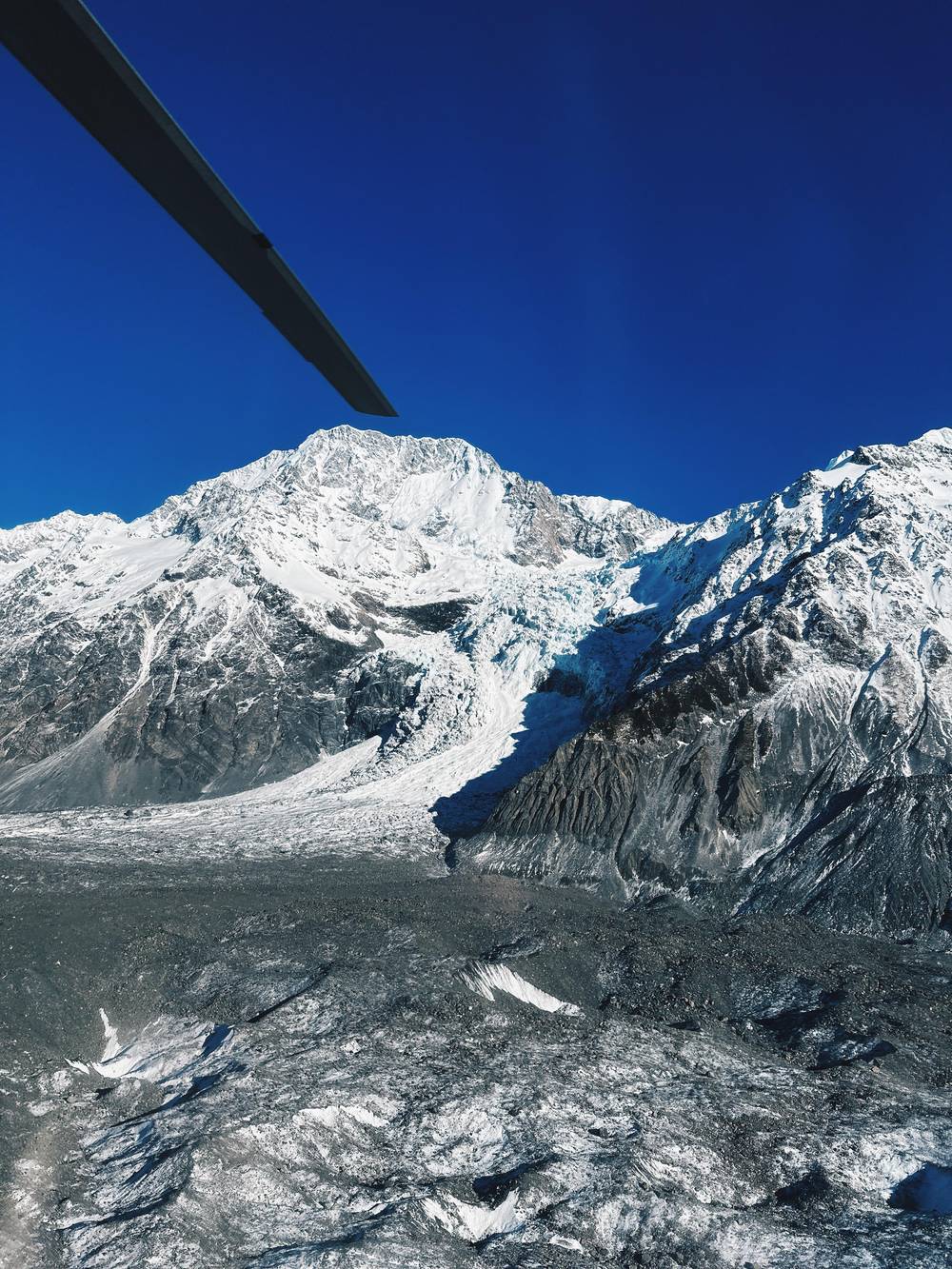
The Tasman Glacier in winter is quieter and whiter. DOC says access to the park may be limited from June to September due to snowfall,5 and that snow can close SH80.34 Tasman Lake freezes over,3 and the toilets at Tasman Valley car park close.22 The visitor centre shortens its hours to 8:30 am - 4:30 pm from May to September.13 Alpine Guides says the village is quieter in winter and rates may be better.35
The heli hike keeps flying. The guiding company runs its trips all year round,7 and adds an extra insulation jacket in winter.36 In the winter months, heli hikers walk in crampons, snowshoes or a combination of both.37 Fresh snow softens the look of the ice, fills crevasses and turns the surrounding peaks brilliant white. Days are short, so the morning slots matter even more for a relaxed drive back.
Winter is ski season on the upper glacier. Mount Cook Ski Planes runs its Ski the Tasman days from 1 July,6 and Alpine Guides schedules its hut-based ski trips from July through October, sometimes into November.38 NIWA explains that seasonal snowfields in the Canterbury mountains build from late autumn and persist to early summer.39 July is also one of the drier months at the village, with a normal of 265 mm.1
Any season
What a morning on the ice costs for your group
Compare the year-round ways onto the glacier.
Compare 3 side by side
What a morning on the ice costs for your group
Compare the year-round ways onto the glacier.
- Our heli hikeUp to 2 hours on ice · starts at, per person $528
≈
View - Second heli hike2 hours hiking · starts at, per person $555
≈
View - Helicopter flightAlpine landing · starts at, per person $223
≈
View
From-prices on GetYourGuide, shown at the ECB reference rate. Your exact price is confirmed during booking.
The glacier year
A year in the Tasman Valley
September
Boats return
The boat season runs from September to June.12
October
Long hours
The visitor centre's summer hours run October to April.13
November
Busy season
The view track gets very crowded until April.4
December
Flowers
December to March brings the alpine flowers.14
June
Winter access
From June until September, DOC says snowfall can restrict entry.5
July
Ski season
Ski the Tasman starts on 1 July.6
Spring and autumn
Spring brings the wind. NIWA puts 35% of the village's strong-wind days in spring,16 and October is the month with the most wet days, 15 on average.2 The glacier boats return to the lake in September,12 and the alpine flowers follow later in the season. Snow can linger low on the slopes well into spring, and avalanches remain possible: DOC warns that no season is free of them in the park.40
Autumn has fewer strong-wind days than spring.16 Rainfall normals at the village are 380 mm in March, 344 mm in April and 365 mm in May.1 Crowds ease after the summer season ends in April,4 the boats run until June,12 and the visitor centre moves to its winter hours from May.13 Early snow on the peaks and the golden tussock in the valley make it a photogenic time to visit.
In the shoulder months, plan for both seasons at once. DOC's park-wide warning applies with special force when the calendar says one thing and the sky another: any season can bring snow, freezing cold, strong wind or sunburn.29 Pack a warm hat and gloves as well as sunscreen, and check the highway conditions as well as the forecast before you drive in.
Video
Winter walks at Aoraki Mount Cook
Mari Johnson on YouTube · Until you tap play, no video is loaded.
New Zealand’s weather is noted for its ability to deliver four seasons in one day at anytime of the year
Pack for the season
A season-proof checklist
Which month for which activity
Each way of seeing the glacier keeps its own calendar. The heli hike runs all year round, weather permitting.7 The glacier boat runs from September to June.12 The guided ski days run in winter, from 1 July.6 The free valley walks are open all year, but in winter you meet snow on the road and closed toilets at the car park.34,22 Flights with a glacier landing operate across the seasons.41
If icebergs are your goal, come in summer, when DOC says they can usually be seen on the lake.3 If you want alpine flowers, aim for December to March.14 If quiet matters more than warmth, consider coming before November or after April, when DOC's busy season is over.4 If you want to ski the glacier, it has to be winter, and you need to be a competent skier: our skiing page explains the options.
Whatever the month, the same rule holds: build slack into your plan. Book the flying activity early in your stay, keep a free valley walk ready for a grounded morning and stay at least one night close to the mountain. With that margin, the Tasman rewards visits in every season, from the floating bergs of summer to the frozen lake and snow-loaded peaks of winter.
Dressing for the Tasman in any month
Even for a short valley walk, DOC asks for solid shoes, warm and waterproof layers, sunscreen and a hat.32 Up on the ice, the guiding company recommends several upper layers, for example a thin shirt under a fleece, topped with a windproof shell.42 Layers work better than one heavy coat, since the briefing room is warm, the flight is cool and the walk on the ice warms you up again.
For winter days on the snow, the ski plane operator suggests wearing one extra layer of clothing beyond what you would wear on a day at a ski field.33 Gloves and a warm hat belong in every bag. The guiding company advises against jeans, which become heavy and cold when wet, and suggests track pants or long pants instead.43
Protect your eyes and skin in every season. Snow glare on the glacier is very strong,31 and UV is high all year at this altitude.30 Sunglasses, sunscreen and lip balm are as important in July as in January. Our guide to the hike on the ice goes through the kit the operators lend and what you bring, season by season.
FAQ
Questions answered quickly.
Which months suit a visit to the Tasman?
Tourism New Zealand rates the months from October to April as the best for walking the park's tracks.24
How much rain falls at Mount Cook?
NIWA's 1981-2010 normal for Mt Cook Village is 4285 mm a year.1
Does the heli hike run in winter?
Is the road open in winter?
When can I see icebergs on the lake?
Summer is iceberg season on the lake; in winter its surface freezes, DOC says.3
How cold is it on the glacier?
The ski plane operator says landing sites are typically 1-3 degrees cooler than the airport.9
Sources
- NIWA (now Earth Sciences New Zealand) · The climate and weather of Canterbury, 2nd edition, 2016 (PDF) ↩
- NIWA (now Earth Sciences New Zealand) · The climate and weather of Canterbury, 2nd edition, 2016 (PDF) ↩
- Department of Conservation (DOC) · Tasman Lake and River Track ↩
- Department of Conservation (DOC) · Tasman Glacier View Track ↩
- Department of Conservation (DOC) · Aoraki/Mount Cook National Park ↩
- Mount Cook Ski Planes and Helicopters · Ski The Tasman ↩
- Mt Cook Glacier Guiding · FAQs ↩
- NIWA (now Earth Sciences New Zealand) · The climate and weather of Canterbury, 2nd edition, 2016 (PDF) ↩
- Mount Cook Ski Planes and Helicopters · FAQs ↩
- Alpine Guides (Aoraki) Ltd · Tasman Glacier Heli-hike ↩
- NIWA (now Earth Sciences New Zealand) · The climate and weather of Canterbury, 2nd edition, 2016 (PDF) ↩
- Mackenzie Region tourism (Mackenzie NZ) · Glacier Explorers ↩
- Department of Conservation (DOC) · Aoraki/Mount Cook National Park Visitor Centre ↩
- Tourism New Zealand (newzealand.com) · Things to see and do in Aoraki / Mount Cook ↩
- NIWA (now Earth Sciences New Zealand) · The climate and weather of Canterbury, 2nd edition, 2016 (PDF) ↩
- NIWA (now Earth Sciences New Zealand) · The climate and weather of Canterbury, 2nd edition, 2016 (PDF) ↩
- Mt Cook Glacier Guiding · FAQs ↩
- Mount Cook Ski Planes and Helicopters · FAQs ↩
- Mt Cook Glacier Guiding · FAQs ↩
- Alpine Guides (Aoraki) Ltd · FAQ ↩
- Mt Cook Glacier Guiding · FAQs ↩
- Department of Conservation (DOC) · Tasman Glacier View Track ↩
- Tourism New Zealand (newzealand.com) · Things to see and do in Aoraki / Mount Cook ↩
- Tourism New Zealand (newzealand.com) · Things to see and do in Aoraki / Mount Cook ↩
- Department of Conservation (DOC) · Tasman Glacier View Track ↩
- Alpine Guides (Aoraki) Ltd · FAQ ↩
- Mount Cook Ski Planes and Helicopters · The Adventurer: Tasman Glacier Heli Hike ↩
- Mt Cook Glacier Guiding · FAQs ↩
- Department of Conservation (DOC) · Tasman Glacier View Track ↩
- Alpine Guides (Aoraki) Ltd · Tasman Glacier Heli-hike ↩
- Mount Cook Ski Planes and Helicopters · FAQs ↩
- Department of Conservation (DOC) · Tasman Glacier View Track ↩
- Mount Cook Ski Planes and Helicopters · Ski The Tasman ↩
- Department of Conservation (DOC) · Tasman Glacier View Track ↩
- Alpine Guides (Aoraki) Ltd · FAQ ↩
- Mt Cook Glacier Guiding · FAQs ↩
- Mount Cook Ski Planes and Helicopters · The Adventurer: Tasman Glacier Heli Hike ↩
- Alpine Guides (Aoraki) Ltd · Ski The Glaciers ↩
- NIWA (now Earth Sciences New Zealand) · The climate and weather of Canterbury, 2nd edition, 2016 (PDF) ↩
- Department of Conservation (DOC) · Aoraki/Mount Cook National Park ↩
- Mount Cook Ski Planes & Helicopters (mtcookskiplanes.com) · Frequently Asked Questions ↩
- Mt Cook Glacier Guiding (mtcookguides.co.nz), the operator of the heli hike this site books · FAQs ↩
- Mt Cook Glacier Guiding (mtcookguides.co.nz), the operator of the heli hike this site books · FAQs ↩
Read next