Our pick
The morning heli hike
From Mount Cook Airport
- On the iceUp to 2 hours
- GroupUp to 11
- Start8:45 AM or 10:45 AM
Guides
Language
Currency
See open slotsfrom $528 · no cancel feeInteractive to-do list
The quick version
Mount Cook glacier guiding on the Tasman means up to 2 hours walking the white ice in crampons behind a qualified guide, with boots, waterproofs and every piece of kit supplied.
Ice essentials
Your list · 9 items
Check things off as you go; your progress is kept on this device.
0 / 9 ready
Ready to go. Only the booking is left: pick the morning slot that suits you.
Claim a spotWhat Mount Cook glacier guiding is like once the helicopter lifts away: the kit you are given, how the guide moves the group across the white ice, the hazards they read for you, and what to wear.
Editorial team, tasmanglaciertour.com · Updated November 8, 2026 · Allow 7 min
Summary view
Mount Cook glacier guiding on the Tasman is a slow, careful walk across ice that few people ever reach on foot. The trip on this site sets a group of no more than 11 down on the glacier for as long as 2 hours, with a 15-minute helicopter ride at either end. No experience is needed: the guiding company supplies the specialist equipment and teaches you to use it.8
The guides are professionals. Mt Cook Glacier Guiding says its guides are fully qualified, or training, as Hard Ice Guides and Alpine Trekking Guides through the New Zealand Mountain Guides Association.9 Alpine Guides, which guides the rival heli hike sold by the Helicopter Line, has worked in the park since 1966, and the Mackenzie tourism body calls it the country's longest-established mountain guiding company.10
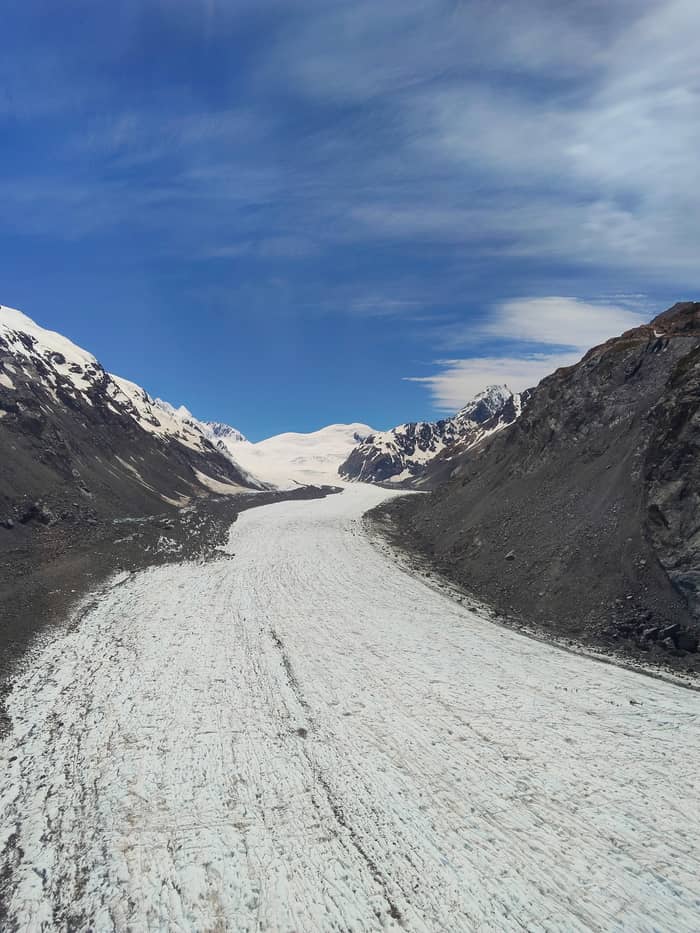
The guiding company itself says that flying in by helicopter or ski plane is the best way to experience the glacier.11 That is because the ice worth walking on lies far up the valley, beyond the rubble and moraine you see from the road. This page walks you through the morning from the airport desk to the last step back into the helicopter.
Kit check
| Item | Our heli hike | Helicopter Line heli hike |
|---|---|---|
| Boots | Leather boots provided2 | Glacier boots provided17 |
| Traction | Crampons or snowshoes2 | Ice crampons or snowshoes17 |
| Waterproof jacket | Provided2 | Provided if required17 |
| Warm layers | Bring 3-4 upper layers18 | Bring warm upper layers |
| Camera | Bring it18 | Large cameras on a strap19 |
Kit as each operator lists it on its own page; ask at check-in if anything is missing from your fitting.2,17
The morning starts indoors. Check-in opens 20 minutes before the meeting time, at the guiding company's counter in the Mount Cook Airport terminal.12 A safety briefing of 45 minutes follows, and this is when boots, crampons and waterproofs are fitted to each guest. Arrive on time: the operator cannot hold a departure for latecomers, and a missed trip is charged.13
The kit list is generous. You get quality leather boots with socks, crampons or snowshoes, poles, a waterproof jacket and overtrousers, plus a hat, gloves and a pack to carry them.2 In summer, guests usually wear crampons for the hard ice; in winter, crampons, snowshoes or a mix of both.14 An extra insulated jacket is handed out in winter.15
Listen closely during the briefing. Guides give their safety instructions in English, and the Helicopter Line asks anyone who cannot follow basic English instructions to come with someone who can translate.16 Ask questions here rather than on the ice: how to walk in crampons, how to step across a meltwater channel, and what to do around the helicopter when it lands.
Where the time goes
Stages as the GetYourGuide itinerary lists them; time on the ice depends on the weather.1
The flight in climbs the Tasman Valley over country the Department of Conservation describes in plain terms: its avalanche scale ranks the floor of the Tasman Valley, as far as where white ice begins, as simple terrain.23 Beyond that point the glacier begins, and most of the park around it is complex avalanche terrain.24 The helicopter carries you past the transition in minutes.
Alpine Guides says its heli hikes land high on the white ice of the glacier, roughly 1,200 metres up.25,26 Down at the terminal lake the picture is different: the lookout on the public track stands on a rocky wall of glacial debris, and the moraine walls around the lake are unstable and hazardous.27,28 That is the part of the glacier most visitors see, and it looks grey, not white.
Stepping out of the helicopter onto clean ice is a surprise in itself. The surface glitters, the air is still and the walls of the valley rise on both sides. Your guide will move the group away from the landing area before the helicopter lifts off again, and from then on, the walk is at the pace of the slowest walker.
Dress for the day
Pick the weather you wake up to and see what to change.
If A clear, sunny summer morning
Layers plus dark glasses
UV is high all year and the glare off the ice is strong.20
If A cold winter morning
Extra layer and snowshoes
An insulated jacket is added in winter, and snowshoes may replace crampons.15,14
If Wind and showers at the airport
Waterproofs over layers
Snow, wind and freezing temperatures are possible in every season.21
If I only packed jeans
Change into track pants
Jeans turn heavy and cold when wet; track pants or long trousers work far better.5
If I get cold hands
Bring your own gloves too
A warm hat and gloves are on the list to bring.18
Ways onto the ice
Our pick
From Mount Cook Airport
Groups of 10
From Mount Cook Airport
Day from Queenstown
From Queenstown by air
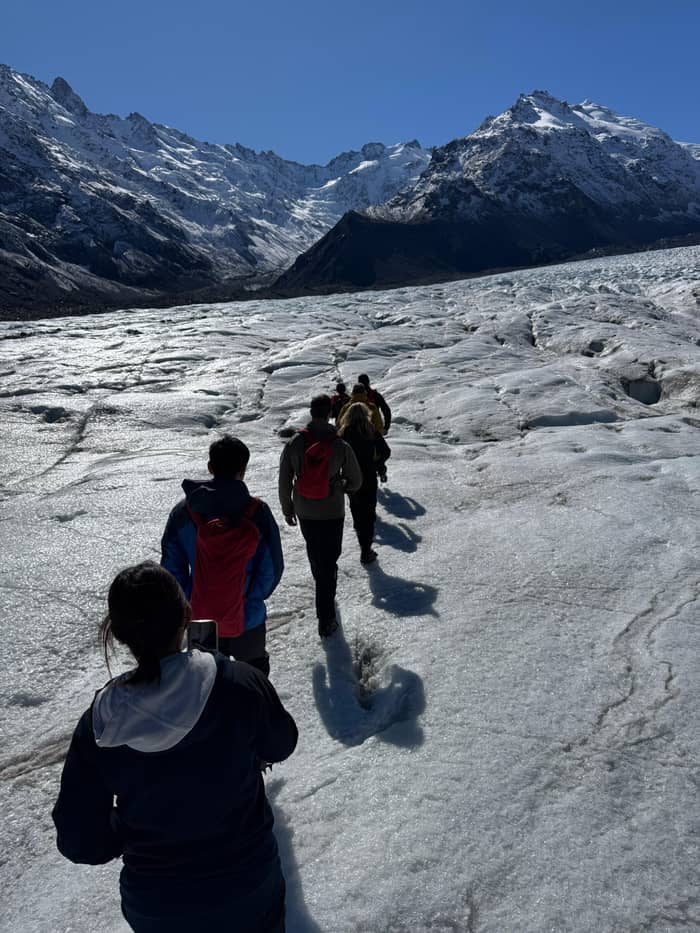
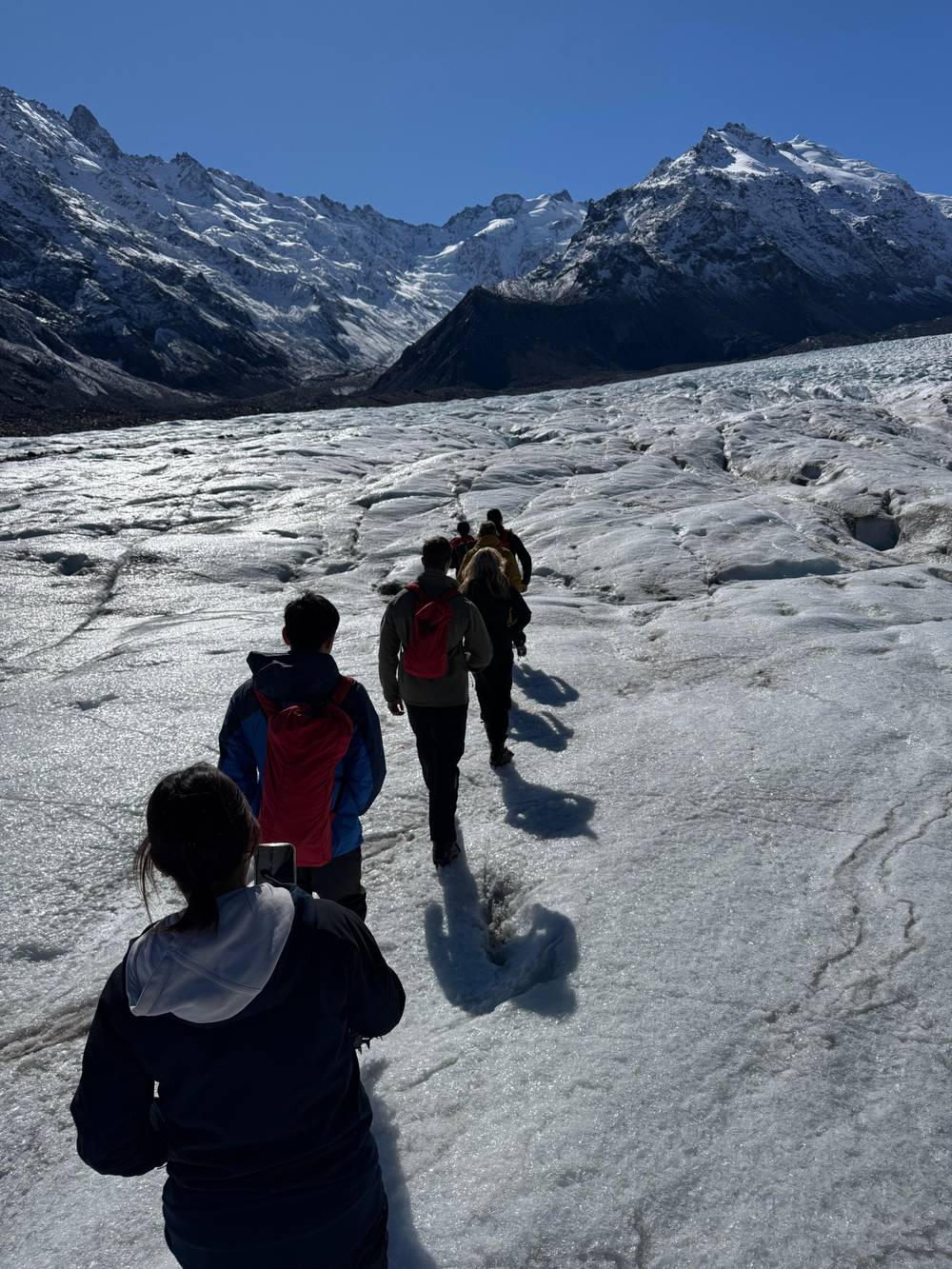
A Mount Cook glacier hike is less about distance than about terrain. The guide leads in single file and, where the ice steepens, cuts steps into it for the group to follow, a skill the guiding company traces back to the country's mountain pioneers.30 You stop often, to look into a crevasse, cross a meltwater channel or take photographs.
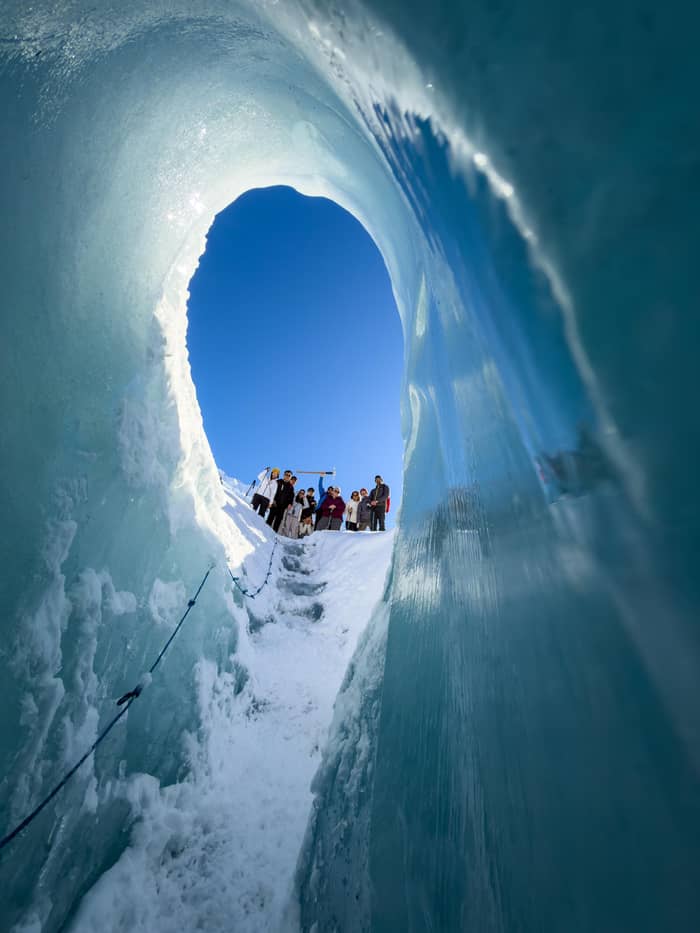
The features change with the season and the day. On its own trips, Alpine Guides reports runnels, moulins, deep blue ice and meandering meltwater streams, with crampons gripping ice it reckons to be 100 years old.22 Caves come and go, and The Helicopter Line cautions that they cannot be promised.32 Your guide decides what the group explores on the day.
The pace is gentle by design. The guiding company describes the fitness needed as being able to keep up a moderate pace, with regular stops, for up to 2 hours, and to climb stairs without holding the handrail.3 The Helicopter Line asks that you can walk at least 1 kilometer and manage stairs easily.33 If you can do that, the glacier will feel like a long, fascinating walk rather than a climb.
Price your group
Choose a group size to price the guided heli hikes on the Tasman.
Compare 4 side by side
Choose a group size to price the guided heli hikes on the Tasman.
≈
View≈
View≈
View≈
ViewFrom-prices on GetYourGuide, shown at the ECB reference rate. Your exact price is confirmed during booking.
Your morning
Check-in
Be at the desk 20 minutes before the meeting time.12
Briefing
A 45-minute safety briefing while boots and crampons are fitted.
Flight in
A 15-minute helicopter flight onto the glacier.
On the ice
Up to 2 hours exploring with your guide.1
Flight out
Fly back in 15 minutes, then a 10-minute pause at base.
A glacier is a moving, cracking mass of ice. The Helicopter Line lists the terrain hazards plainly: falling rocks, cliffs, ice cliffs, crevasses, changing snow, steep slopes, loose rocks and icy surfaces.34 It judges an avalanche reaching the lower Tasman Glacier to be unlikely, but still possible.35 The Southern Alps also sit on the Alpine Fault, where earthquakes can strike without warning.36
Help is far away. The operator warns that its glacier landings and guided hikes may be an hour or more from advanced medical care, and that only basic first aid is available on site.37,38 That is why guides choose the route, rope off hazards and turn back when conditions change, and why a Tasman Glacier hike for visitors should always be a guided one.
Never try it alone. Even at the lake, DOC cautions that stepping onto the ice can cost you your life, and that icebergs are unstable and may roll over.7,6 The public tracks end at viewpoints for a reason. To stand on the Tasman itself, book the guided heli hike, and let a professional read the ice for you.
Video
feralbunny on YouTube · Until you tap play, no video is loaded.
Accompanied by your professional glacier guide, you will discover an amazing landscape of blue ice features, runnels, moulins and winding streamlets.
Dress in layers whatever the month. The guiding company suggests 3-4 layers on top, for instance a thin shirt, a fleece with long sleeves and a windproof shell, under the waterproof jacket it lends you.4,2 The park can serve up snow, frost, gales and sunburn in any month, so a sunny morning at the airport is no promise of warmth on the ice.21
Leave the jeans behind. They turn heavy, cold and uncomfortable once wet, and the guiding company suggests track pants or long trousers instead, with shorts acceptable in summer.5 Bring a warm hat and gloves, sunglasses and sun protection, a drink and some snacks, and any medication you need.18 Alpine Guides adds that UV is high all year.20
In winter the guiding company adds an insulated jacket to the kit, and snowshoes may replace crampons on soft snow.15,14 In summer the ice is harder and brighter, and glare off the surface is fierce, so wear the darkest sunglasses you own. Whatever the season, eat properly before the trip: the airport sells almost nothing to eat.29
You will want your camera, and the operators welcome it. Keep it on a strap: the Helicopter Line asks that large cameras are secured, and bans drones, iPads and selfie sticks on its aircraft.19,39 On the ice, gloves make phones awkward, so set up your settings before you leave the helicopter. Cold drains batteries quickly too: carry a charged phone in an inside pocket and take it out only for the shot.
Drones are out of the question. The guiding company points out that flying a drone in the national park is illegal, and that a drone flown on its trips will be confiscated with a fine of NZD 5,000.31 The view from your own feet is the point of the trip anyway, and the helicopter flight gives you all the aerial angles you need.
Share the photo stops. Recent reviews praise guides who make sure everyone gets a window seat, swapping places for the return flight, while one guest felt that a few people lingered too long at the best spot on the ice. Take your pictures, then step aside: in a group of up to 11, everyone deserves a turn at the crevasse edge.
FAQ
No experience is needed; the guides supply the specialist equipment and show you how to use it.8
The guiding company provides boots, socks, crampons or snowshoes, poles, jacket, overtrousers, hat, gloves and a backpack.2
Climbing stairs without holding on, and walking at an easy pace for 2 hours, is the benchmark.3
Wet denim turns heavy and chilly; track pants or other long trousers are the better choice.5
Crevasses, rockfall, ice cliffs and icy surfaces; the guides choose the route and manage the risks.34
Drones are illegal in the national park; the operator confiscates them and the fine is NZD 5,000.31
Caves form and vanish with the seasons; whether you enter one is the guide's call.32
Sources
Read next
Wondering if the weather will let you fly onto the Tasman? Ask a real person here.